
Your cart is emptyAdd something meaningful and it will appear here.
Toddler Backpack Size Guide for Daycare and Preschool
Compare Name & Kin Small, Large and set dimensions for daycare and preschool, with folder guidance, a fit check and an interactive packing decision list.
 Written byName & Kin
A backpack that fits your toddler’s routine gives spare clothes, familiar belongings and school notes a place of their own. Name & Kin’s individual backpacks come in Small (11.81 × 9.45 × 3.54 in / 30 × 24 × 9 cm) and Large (15.75 × 11.42 × 4.72 in / 40 × 29 × 12 cm). Start with the belongings that travel each day, then check how comfortably your child can handle the packed bag. This guide brings the measurements and everyday choices together.
Start with the daycare or preschool list
Ask which items travel every day and which can stay at the center. A change of clothes and a small comfort item create a different space requirement from a folder, lunch container and extra layer. If bedding stays at school, it does not need to determine the backpack size.
Separate your list into daily items, occasional items and supplies delivered by an adult. This keeps a once-a-month supply drop from driving an unnecessarily large everyday bag. Confirm whether lunch will travel inside the backpack or in a separate lunch bag.
Name & Kin sizes at a glance
Compare the toddler backpack dimensions below against your daily list. The small vs large toddler backpack choice becomes clearer when you measure the largest rigid item and check the bag on your child.
| Option | Measurements | Start here when… |
|---|---|---|
| Small backpack | 11.81 × 9.45 × 3.54 in 30 × 24 × 9 cm |
The daily list is compact, with smaller belongings and no full-size folder requirement. |
| Large backpack | 15.75 × 11.42 × 4.72 in 40 × 29 × 12 cm |
You need more overall room or have a full-size folder to assess against the opening and interior. |
| Matching two-piece set | Backpack: 14.96 × 11.02 × 4.72 in (38 × 28 × 12 cm) Lunch bag: 9.84 × 6.30 × 2.76 in (25 × 16 × 7 cm) |
You need a backpack and a separate lunch bag. The set has a fixed backpack size. |
For a 9 × 12-inch (22.9 × 30.5 cm) folder: its closed size is about 9 × 12 in (22.9 × 30.5 cm). Small’s listed height is 11.81 in (30 cm), so choose a larger option to assess for flat, upright folder storage. Start with Large, then confirm the opening and usable compartment with the actual folder. Overall measurements help narrow the choice but are not the same as internal clearance.
For a child’s age or height: use the table as a bag comparison, then try the fit on the child. We do not assign these sizes to a fixed age or body-height range; the child’s proportions and packed load matter alongside the measurements.
Measure the items that cannot bend
Measure the actual folder, lunch container and bottle you plan to use, including handles and protruding lids. For a folder, note height and width; for a lunch box, include depth. Compare these with the usable compartment and opening, not only the outside dimensions.
Check the corners as well as the height: a rectangular folder needs room to pass through a rounded zipper opening. Not sure about a particular folder or lunch box? Send our team its measurements and we can help you review the size and fit details before you personalize.
Check the bag on the child
Where possible, try the bag with the intended daily load. Adjust both shoulder straps and ask the child to walk, turn, sit and reach the zipper. Watch whether they can handle the bag comfortably and whether it gets in the way during ordinary movement.
Choose a bag your child can manage comfortably with today’s essentials inside. A little spare room can be useful for an extra layer, but the current fit and school list are the most helpful starting points.
Use a simple decision checklist
- ☐ Confirm the daily list: Separate school-day essentials from supplies that stay at the center.
- ☐ Measure the largest rigid item: Include the folder edges or lunch box lid, latches and handles.
- ☐ Compare the space: Check both the usable compartment and the opening.
- ☐ Plan for lunch: Decide whether containers travel in a separate bag.
- ☐ Try the packed bag: Check straps, comfortable movement and access to everyday items.
- ☐ Review the order: Confirm the selected size, name spelling and available options.
Choose for their daily routine
Both individual products below offer Small and Large. The words Daycare and Preschool describe the routine, not a preset size. Open either product to choose the size you want; the card price is the starting price, and your selection determines the final price.
- Daycare backpack: Start with the center’s clothing, drink-container and comfort-item list, then choose Small or Large.
- Preschool backpack: Start with the classroom’s folder and supply requirements, comparing Large first when a 9 × 12-inch (22.9 × 30.5 cm) folder is required.
If packed meals need their own bag, the matching set adds a separate lunch bag, with the child’s name on both pieces. Its backpack dimensions are listed in the table above.
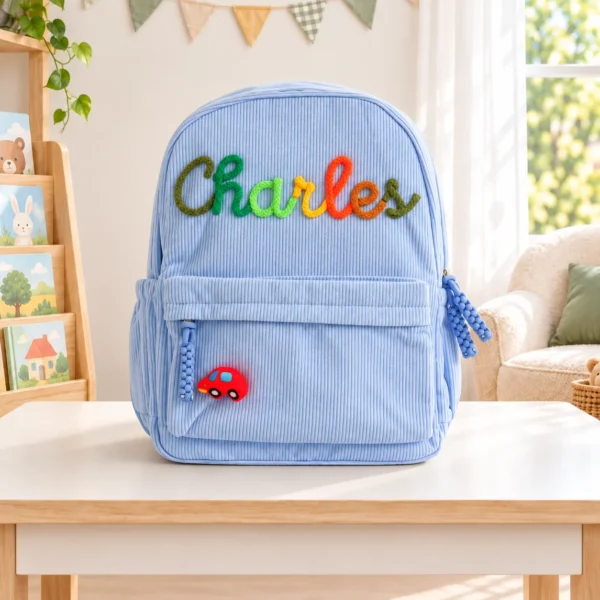
A bag for the daycare routine
Give daily belongings a personal place of their own, with a corduroy backpack chosen around the center’s packing list.
- Choose Small or Large
- Raised yarn name lettering
- A useful option when lunch already has its own bag
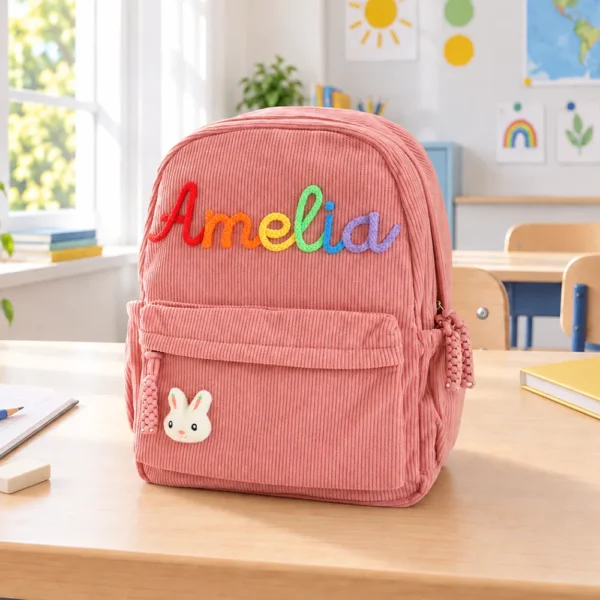
Make their preschool bag personal
Choose a favorite color and a name they know, then select the size that suits the classroom list.
- Small and Large options
- Check folder fit and the zipper opening
- Review the name and selected size before ordering
Frequently asked questions
Is there one correct backpack size for a two-year-old?
For a two-year-old, start with the actual daily belongings and how the bag fits that child. Small is 11.81 × 9.45 × 3.54 in (30 × 24 × 9 cm) and Large is 15.75 × 11.42 × 4.72 in (40 × 29 × 12 cm); use those measurements to compare, then try the loaded bag rather than choosing by birthday alone.
Does a preschool backpack need to fit a folder?
Choose around your preschool’s actual requirement. If a 9 × 12-inch (22.9 × 30.5 cm) folder travels home, compare Large first and check its opening and usable interior. If communication is digital or only small notes travel, a full-size folder may not need to determine the bag.
Should I size up for extra clothes?
Try packing the requested outfits alongside the bottle and other essentials first. Move up a size when that actual load needs the room and the larger bag is comfortable for your child to manage. Bulky seasonal clothing can change the packing list.
Related guides
Your feedback
Was this article helpful?
A quick answer helps us make future guides more useful.